
The Onboarding Gap in Figma Design Systems
Designing a governance framework for safer collaboration and faster onboarding

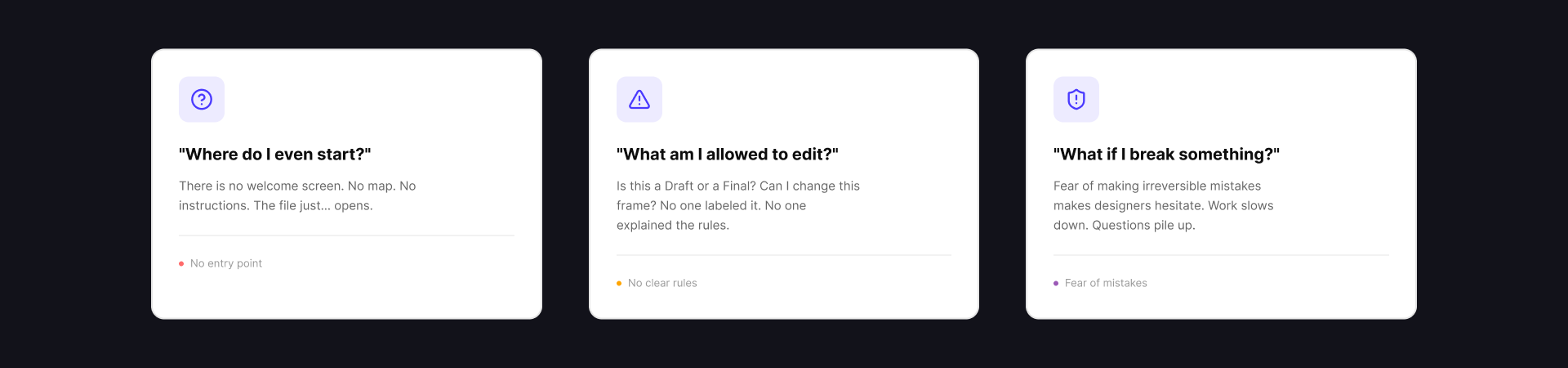
This project began with a situation I experienced myself. When I joined a client's Figma design system, I remember feeling overwhelmed by the amount of information inside the file. There were shared components, pages, libraries, and existing structures that I didn't fully understand yet. More importantly, I was afraid of changing something that might affect other designers or break a shared component.
I realised that the problem wasn't simply that the design system was complex. I didn't know where I was supposed to start, what I was allowed to change, or how I could safely become part of an existing design environment.
That experience made me curious about what happens when a designer enters a large design system for the first time. How do they understand the structure? Where do they learn the rules? How do they know what is safe to edit, review, or contribute to?
This became the starting point for my MA thesis: The Onboarding Gap in Figma Design Systems.

The Onboarding Gap
As design teams grow, their Figma environments also become larger and more complex. Remote collaboration, increasingly sophisticated design systems, and the absence of clear onboarding standards can make these environments difficult to navigate, especially for designers who are joining an existing system.
Through this project, I began looking at onboarding not simply as documentation or an introduction to a tool, but as an experience in itself.
A new designer should not have to learn a design system by guessing. They should be able to understand where to begin, how the system is organised, what they can safely interact with and how they can gradually become a participant.
Research Question
This led me to my main research question:
How can governance structures within Figma design systems reduce cognitive load and improve onboarding for new designers?I
approached the research through three connected goals. First, I wanted to understand the challenges designers face when entering large-scale Figma systems. Then I wanted to translate those findings into a practical governance framework. Finally, I wanted to evaluate whether governance could improve confidence, navigation, and collaboration.
From Design System to Participation Environment
One of the biggest shifts in my thinking during the project was moving away from seeing a design system as simply a collection of components. A component library can tell you what exists, but it doesn't necessarily tell a new designer where to start, what to do next, or how to participate safely. I therefore started thinking about the design system as a participation environment. The system needed to provide orientation and guidance alongside its visual assets and components. This became the foundation for my proposed solution: the Figma Governance Toolkit (FGT).
Figma Governance Toolkit
The Figma Governance Toolkit is a governance framework designed to improve onboarding inside Figma.
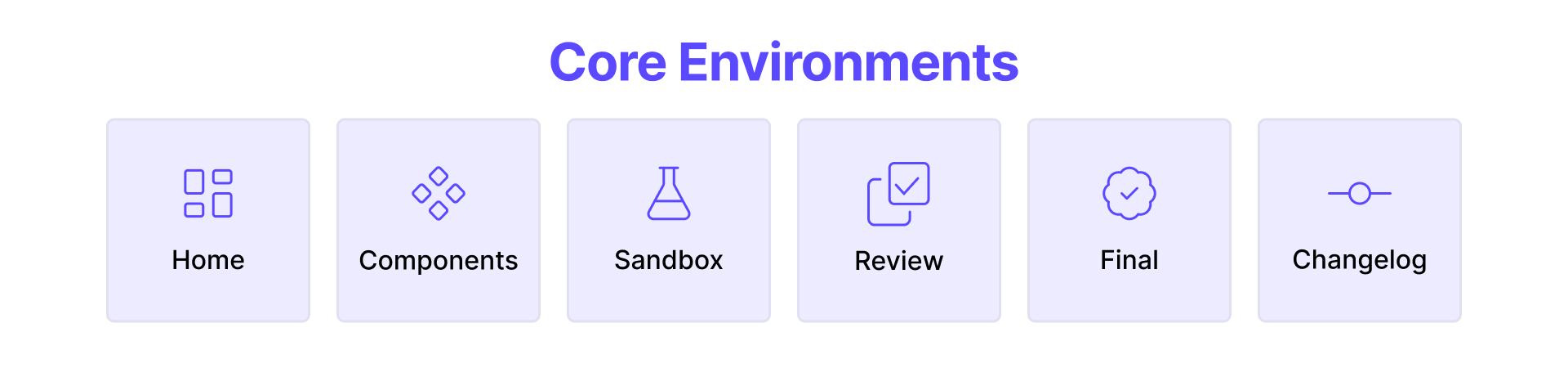
Instead of placing governance somewhere outside the design process, I explored how it could become part of the Figma environment itself. The framework organises the experience into several core environments: Home, Components, Sandbox, Review, Final, and Changelog.
Each environment has a different purpose within the designer's journey. Together, they create a clearer path through the system from understanding where you are to exploring components, experimenting safely, submitting work for review, and understanding what has changed.
The goal was to transform a potentially confusing design system into a structured participation environment.
How the Experience Works
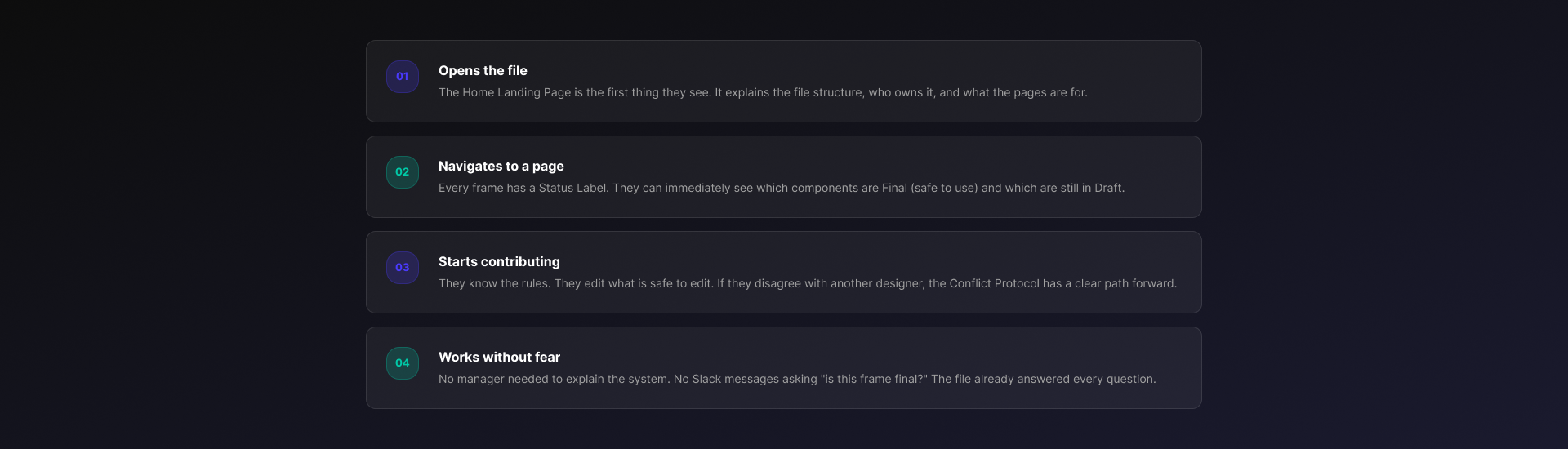
I designed the FGT around the idea that a new designer should be able to gradually move from orientation to participation.
The Home environment provides the starting point. Instead of opening a large and unfamiliar Figma file with no clear direction, the designer gets an entry point into the system.
From there, Components provides a structured place to understand and use the existing design language. The Sandbox creates a safer environment for experimentation, allowing designers to work without immediately affecting shared or final assets.
Once a designer is ready to contribute, the Review environment creates a clearer transition between experimentation and shared work. The Final environment represents approved work, while the Changelog provides visibility into how the system evolves.
This structure was designed to make the rules of participation more visible rather than leaving designers to discover them through trial and error
Designing for Confidence
A key part of the project was understanding that onboarding is not only about knowledge. It is also about confidence.
When I first entered a client's Figma system, my hesitation came partly from not knowing whether an action was safe. I wanted the FGT to address that uncertainty by making the boundaries of the system more understandable.
The Sandbox, for example, is not simply another page in the file. It represents a permission to explore. The Review environment creates a transition between personal experimentation and shared contribution. The Final environment provides clarity about what has already been approved.
In this way, governance becomes part of the user experience rather than an invisible set of rules.
Research Through Design
Because this was my MA thesis, I approached the project through Research Through Design using a mixed-methods approach. My research included a technical audit, comparisons between Git and Figma governance, expert interviews focused on DesignOps onboarding, and user testing that compared messy and governed Figma files.
The theoretical foundation also brought together ideas from Cognitive Load Theory, Onboarding Theory, Design Systems and Atomic Design, Git workflows and version logic, DesignOps and design governance.
This combination allowed me to look at the problem from both sides: the practical experience of navigating Figma and the broader organisational structures that influence how design systems are maintained.
Evaluation
I tested the prototype to understand whether the governance structure actually changed the onboarding experience.
Participants reported a better understanding of the system, greater confidence, easier navigation, reduced cognitive load, and less need for verbal guidance.
For me, one of the most important findings was that governance doesn't necessarily need to feel like bureaucracy. When it is embedded thoughtfully into the design environment, it can actually make participation easier.
The core finding of the research was that building governance into the design process can improve collaboration and participation.
What I Learned
This project changed the way I think about design systems.
Before this research, I mainly thought about design systems in terms of consistency, reusable components, and scalability. Through the thesis, I started seeing another important dimension: understanding.
A system can scale the product, but if people don't understand how to enter, navigate, and contribute to it, that scale can also create complexity.
The Figma Governance Toolkit therefore became an exploration of how design systems can scale not only products, but also the people working within them.
My Thesis Contribution
The project contributes a governance framework that treats onboarding as part of UX rather than as something that happens separately through documentation or verbal instruction.
It explores three connected ideas: participation environments, embedded governance, and onboarding as UX. It also considers the cultural side of governance, where clarity, orientation, and accountability can become part of how a design team works together.
Final Reflection
The biggest lesson I took from this project is that a design system should not only tell designers what to use. It should help them understand how to participate.
My own feeling of being afraid to “break something” when I first entered a client's Figma system became the starting point for a much larger investigation into onboarding, governance, and collaboration.
The final idea is simple:
Design systems should not only scale products. They should also scale understanding.
For me, that is what makes a design system successful: not the number of components it contains, but whether a designer can enter it, understand where to begin, and contribute with confidence.

Project details
Discipline
Output
Figma Governance Toolkit
Governance framework + prototype
Onboarding experience
Explored
Design systems ➔ Onboarding ➔ Governance ➔ Cognitive load ➔ Collaboration ➔ Participation environments